The Equestrian Culture of Alona
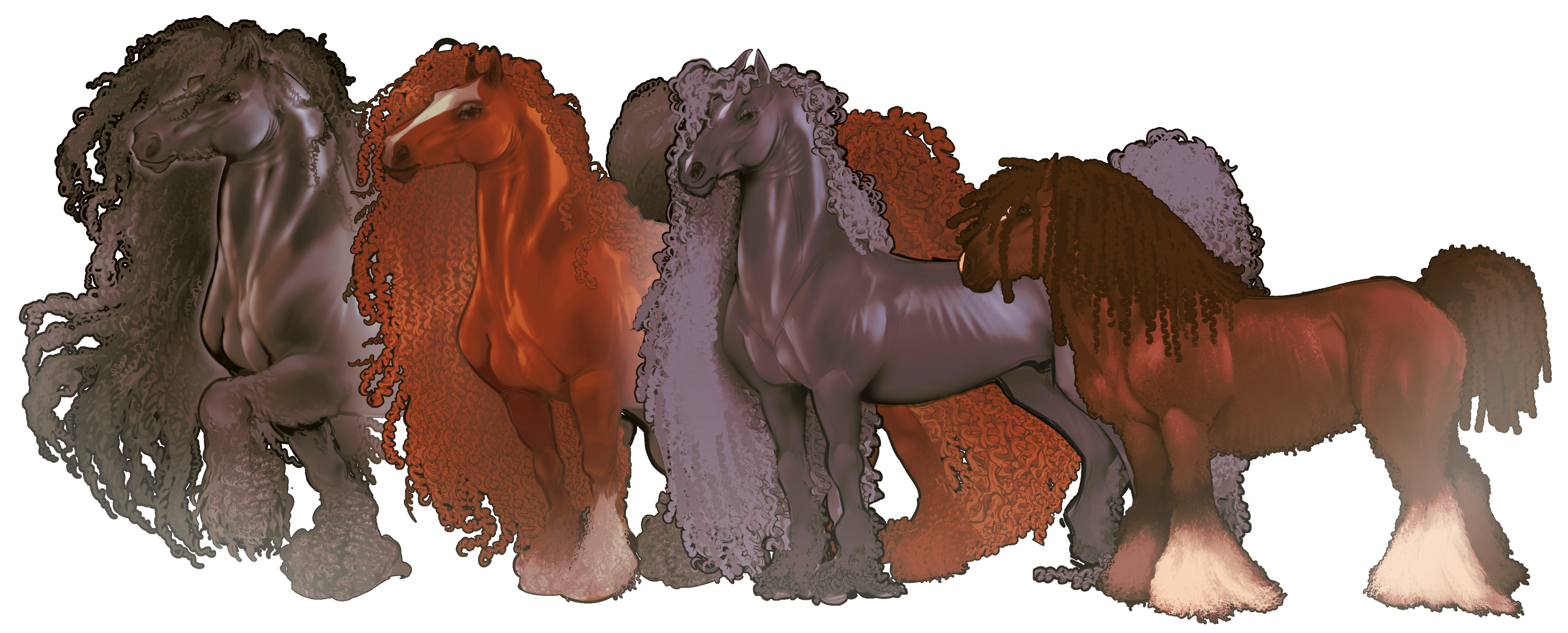
The Sharmeely breed is a collection of four horse variant–subtle differences in their builds and features–the original being the Richqi Horse, with four distinct variations based on selective breeding.
The world of Alona is inspired by action/mystery/romance “isekai” worlds. In Alona, when the country of Tempel attempted to adopt communism, Emperor Hana’s father launched a military campaign to prevent its spread to other nations and save countless lives. After his father’s death in battle, Hana ascended to the throne and continued his father's mission. Following five long and grueling years of conflict, Tempel finally surrendered to the Empire of Uzhua. In the three years since, the Sharmeely family—known for their unique colors and characteristics—has quickly become a royal staple, deeply woven into the fabric of the empire’s blossoming culture. The Sharmeely is a powerful, even-tempered, and beautiful workhorse influenced by Arabian, Indo-European, and heavy draft breeds. This graceful breed closely resembles the Percheron, with key differences such as a longer back, long, curly mane and tail, and distinctive curved ears. This sturdy breed carries Arabian blood, making them a sportier workhorse without taking away from their stature or muscular frame.
Today, the Sharmeely horse is recognized as a national symbol of victory, often celebrated with ornate decorations, intricate braiding techniques, and elaborate shows that showcase the many unique qualities of the breed. These gentle giants are paraded through the streets during most national holidays, but particularly on the National Day of Liberty once a year. The Sharmeely’s distinctive features are highlighted through traditional costumes and accessories, serving as a reminder of the empire’s triumphs and the bond between man and steed.
The Sharmeely horse is a generally large, draft breed that boasts strong baroque characteristics. With long backs that contrast with their shorter necks, tails, and legs, these horses are not known for their speed. However, for what they lack in agility, they more than compensate for with remarkable strength. Visually, they resemble breeds such as the Friesian, Percheron, and Clydesdale. While the Shal Amene and Shenpei may share a few more features with the Akhal-Teke, the Sharmeely Horse's most defining traits align closely with those of heavy draft breeds.
War stories recount tales of a single Meely Coldblood carrying four fully armored soldiers at once. This massive, reliable horse became legendary as a battle-changing steed, enabling the rapid transportation of troops to the frontlines. Many fans of the breed credit it as one of the key factors that allowed the Uzhuan Empire to prevent the world war from lasting more than half a decade.
The native hot-blooded horse of the Uzhua Empire. Within the past decades, it has been the select favorite horse of the Emperor, who has dedicated an annual festival in its honor. The day is called Liberation Day, and it is celebrated by decorating the equines in all kinds of colorful attire, but all with a common armor motif present in order to honor the nation's victory in war.
A native draft horse from Tempel. They have thick, curly coats and shorter manes. Their easy temperament and high fertility made them excellent work horses–and terrific export products. Tempeli Draft horses can be found all over the world of Alona.
A work horse bred over the last 10 years in the Uzhua Empire by breeding the Shal Amene variant with the Tempeli Draft. They are almost indistinguishable from the Shal Amene aside from the fact that they have a slightly broader frame.
The largest of the family with the best traits of the Shal Amene, Tempeli Draft, and Shenpei. Their long backs, powerful withers, and dense musculature make them fit for any task. This coldblood breed is known for its power, cool temperament, and beautiful curly coat.
| Variant | Height Range | Description |
|---|---|---|
| Richqi Coldblood | 17.5hh to 21.0hh | The original breed that begat all Sharmeely horses. This humongous, yet elegant horse was the perfect horse to cross-breed into select varieties, while preserving their elegance, curly hair, and long backs. |
| Tempeli Draft | 16.0hh to 18.5hh | This highly fertile draft horse was brought into the mainland following the war, and quickly gained popularity for their adaptability. These smaller, yet hard-working draft horses were cheaper for commoners to feed while keeping up with the same intense farm chores. |
| Shal Amene | 13hh to 16.5hh | The native hotblood-type steed of Uzhua. Over many centuries, this smaller, hot-tempered breed has been bred to sport many coat colors. The Shal Amene has long been used as a cavalry horse, show horse, or for entertainment. |
| Shenpei | 15.0hh to 19.5hh | This breed is commonly found in more populated areas surrounding the Uzhua Empire. This breed is newer, only being bred over the last 100 years, making them a more coveted variety. |
- Extended Feathering (Optional)
- Thick muscular necks
- Very long backs
- Curly main coats
- Curved ears
- Arabian-like face
- Curly feathering (optional)
- Baroque appearance
Platinum
- This dilute causes a “blue gray” tint to be in the coat.
- Desaturates the base color in a way similar to champagne.
Stone
- Causes a warm gray/sandy color to dilute the coat.
- The darker the base color, the grayer the coat.
- Creates a natural marking with dramatic dark and light points.
Wine
- Causes a deep, fruity orange/red color.
- Darkens and dilutes the coat.
Loden
- Warms and yellows the coat into a mossy green tone.
- Mixes yellow and gray hairs into the coat.
- Evens out dark points on most base colors.
- Note: Hidden by Wine. Wine always visually dominates Loden.
- Example: Wine Stone Champagne (Carries Loden) = Ynstn nTh nCh
🟢Common
- rlrl (rosal): Turns the skin pink underneath the basecoat.
- rl_ = heterozygous, not showing
- nrl = carries rosal
- Rd_ (radish): Darkened reddish freckles on head, neck, dorsal, shoulders.
- St_ (stained): Dark marking following darkest basecoat color.
- Appears in natural white margins.
- Minimum: fully hidden.
- Maximum: fills entire natural white region.
- Cst_ (crest): Irregular white marking behind forelock and head, down neck.
- Does not cross into withers.
- crncrn_ (cornish): Creates irregular “holes” in white markings.
- Spots no larger than pupil.
- Sph (seraph): White marking along topline/dorsal stripe.
- Maximum: thin dorsal stripe + white forelock.
- Minimum: affects only forelock; may gradient tail.
🟡Uncommon
- Pr_ (primal): Zebra-like striping.
- Minimum: affects dun-like areas.
- Maximum: affects entire coat.
- grgr (jaguar): Dark leopard-like spots with light centers.
- Black coats show only lightened spots.
- gr_ = heterozygous, not showing
- ngr = carries jaguar
- Br_ (brindle): Jagged dark stripes within frame.
- Minimum: light stripes between flank and stifle.
- Maximum: stripes extend to withers.
- Sp_ (Sunspur): Black marking around eyes.
- Bred to combat PXS.
- Minimum: borders eyes, may roan outward.
- Maximum: covers entire face but not past forelock/jaw.
- Wh_ (willowed): Coat grays with curved streaks (“striped fading”).
- Bb_ (blotted): Indistinct dark markings not touching frame.
- epep (espur): Extends mapping around white markings.
- xp_ = heterozygous, not showing
- nxp = carries expose
- Minimum: blurred white edges.
- Maximum: 50% opacity white bleed around markings.
🟠Rare
- PXS_ (Phoenix Syndrome): Causes red-orange eye color range due to red-hue color blindness.
- Accidental result of breeding fiery red chestnut.
- Cpd_ (caped): “Cape” where coat color switches off to reveal base color.
- Maximum: fully hidden.
- Minimum: partial reveal.
- plrplr (polaris): White markings replaced by another basecoat color.
- plr_ = heterozygous, not showing
- nplr = carries polaris
- Cw_ (crown): Distinct layered coat color sections.
- Maximum: full basecoat on head/neck.
- Minimum: three layered dilution sections.
- Hp_ (hotspur): White freckles that disrupt white patterning.
- revrev (reverse): Inverts all white markings (not natural white).
- nrev = heterozygous, not showing
- revrev = carries inverse
- dckdck (docket): Extends tailbone 1.3× normal length.
- Often docked by breeders → too-long tail or stub.
- Offsets center of balance.
- ndck = heterozygous, not showing
- dckdck = carries rapunzel
🟢Common
- Heterochromia: Natural heterochromia where it normally wouldn’t appear.
- Birdcatcher Spots: Small random white spots on solid coats.
- Bend-Or Spots: Random dark patches from red to black.
- Vitiligo: Irregular pigment loss on coat, skin, mane, tail.
🟡Uncommon
- Swarry: Disrupts mapping of markings.
- Smooth → Irregular edges
- Irregular → Rough edges
- Rough → Smooth edges
- Undercoat: Undercoat cannot be shed.
- Fuzzy topline/dorsal.
- Beard + extended whiskers.
- Extra feathering (not full unless Richqi).
- Chimera: Patch of another basecoat color up to 1/3 of body.
- Color rarity rolled up to original basecoat rarity.
- Luster: Unnatural eye color or colored rings.
- Causes light sensitivity + color blindness.
🟠Rare
- Shorthair: No feathering or extra hair.
- Finer, thinner, more shedding coat.
- Shorter mane/tail possible.
- Emperor: All markings void on head.
- Thought to be somatic expression until a genetic consistency was discovered.
- Cift: White or black mane/tail depending on basecoat.
- ee_ → white to cream-blonde hair.
- E_ → smokey blue-black to pure black hair.
- Does not override marking-induced hair color changes.
- Maximum: entire mane/tail.
- Minimum: at least one (mane or tail) under white modifiers.
- Brindle: Rough, discolored striping of light and dark hairs.
- Extends from neck to flank.